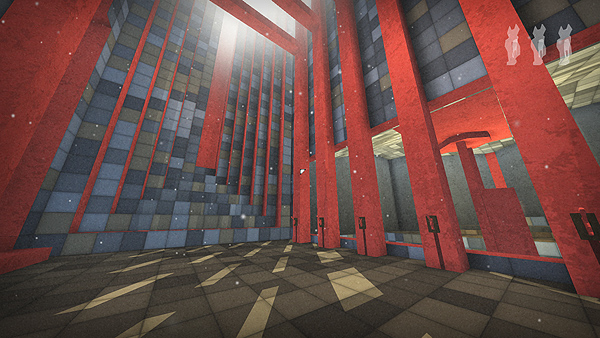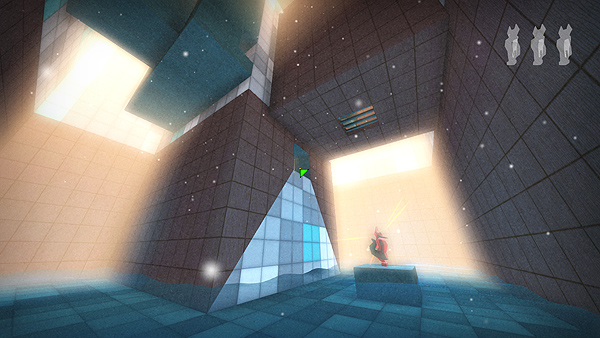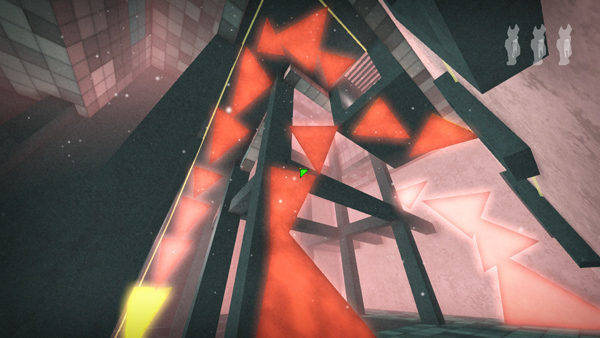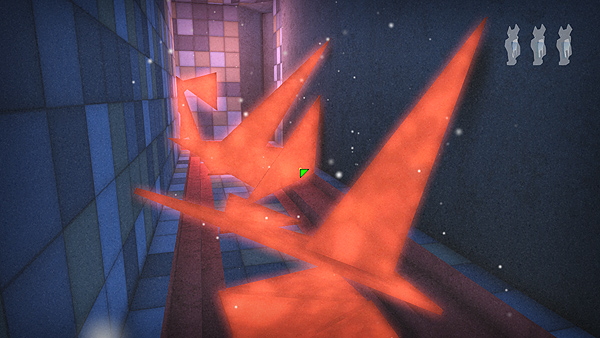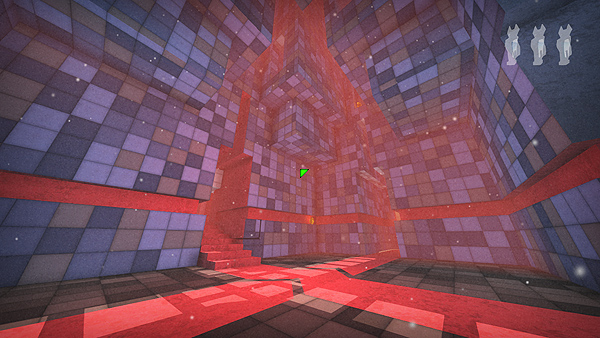
Just in short, a longer report will follow, soon. But you can now kickstart TRI together with 8 other indie games.
Category «Marketing»
The pros and cons of making a game alpha

Although games, websites or software in beta state always have the touch of banana software ("ripens at the customer's"), testing and using a feature-complete, but buggy version is popular these days. You don't even recognize the "beta"-button anymore.
In contrast to the beta, the alpha version of a game lacks the implementation of most features, levels or functions. The game is just a skeleton that needs to be fleshed out and wrapped into a nice skin, before anyone can estimate where this new thing will walk to. Some developers go even so far to present just a grid you can walk on as a first gameplay demo.
How did game development come this far, to sell even the slightest appearance of gameplay? Are we that desperate? And why do so many of these pre-pre-alphas pop-up these days?
Coincidentally I'm one of them, selling my game in an early development phase. Although we fuel a culture of incompleteness with this approach, that - above all when it comes to indie games - creates a certain reputation, I try to give you some insights on my opinion about alphas.
The customer
First of all - why should a player be bothered with this early versions? This is a question you should ask yourself when you sell an unfinished product. Your argumentation should be clear, more so if you want money for your game-to-be-made. If you have fans that really wait for your game, this will make some things easier:
- Discount
- Have a clear vision what your game will be worth when it's finished, to give a visible discount (e.g. 50% off). Players love discounts and get a price deduction for their patience and trust in your upcoming game project.
- "Try it before it's finished!"
- Only those players who fund you will be able to try your gameplay in this early state. This is convincing if you have gameplay that is unique and fans that are eager to try it. Why should players wait a year, when they can have a piece of this tasty cake now? Just make clear what features the current version contains and which one will be added with future updates.
- "Fund your developer <3"
- An appreciating fanbase and people loving to support your kind of games is awesome! If you already have fans, you should communicate why you need the money and what you need it for.
- Many developers therefore use different alpha packages in regular priced and higher priced versions with more extras like soundtrack, artworks, etc. For example, Tale of Tales are quite successful with the "extravagant" version of their upcoming Bientôt l'été, which costs $32 instead of the regular $8.
- "Participate in game our development!"
- How much you want your players to be part of the development process is your decision, but don't use this argument only because it sounds good. People love to bring in themselves with opinions and solutions. If you ask them to take part, you must not ignore that in updates.
- We did a survey about the good, the bad and the ugly right in the beginning.
- "Watch the evolution of a game!"
- Regularly updated alphas are a playable time-lapse. With every update the vision gets clearer, more beautiful and filled with textures, characters and decoration (well, at least that's our plan). Many people love to take a look behind the scenes. Combined with blogging and video documentation it is interesting how a game evolves.
Although I am a game designer, I am a player myself, too. I have stabs at many alphas and love to play upcoming and promising games in this early state. Playing games before even the press got an eye on these games!
One argument that really kills all the above enumerated pros is one contra though: Players will never have the certainty that a game they bought will get finished! The more alphas are out there, the more developers will occur that abort their projects or never show up again.
We hope to eliminate this impression by updates and postings. Even if there will be a bigger pause of development because of different engagements or other circumstances, you should communicate this to your players.

The developer
But to be honest: The one that benefits most from an alpha is the developer, of course. There are many arguments to sell your game before it's finished:
- Fund your game!
- Naturally, there won't be that much coverage about an alpha than a finished game. It's hard to really get recognized, taken seriously and funded in this state! We would need to sell 800 copies a month to really be independent from doing contract work (with the current price of $5 for TRI and extremely economized lifestyle).
- But it is possible and we try to achieve that with the next updates, hopefully.
- Marketing is easier step-by-step
- When it comes to marketing, I make tons of mistakes. Writing press releases too late, forgetting that things need to be tested or news need to be approved by certain sites. Timing is something I'll never learn!
- In my opinion marketing an alpha game is easier. You failed to write about your last update? There will be another one soon that makes everything better, with cool character art and exclusive environmental decoration updates.
- Selling a game in the moment it comes out proves to be extremely difficult. Everything has to fit in this certain time frame. With the alpha you are able to try out different approaches in marketing and failures are not that much punished with ignorance.
- Feedback and play-test
- An immense advantage of our alpha version is the survey we are doing. Many people participated by answering what they liked, hated and where they got stuck. Of cause we did do play-tests at our headquarter with friends. But having more than 10 people testing it by their own desire (instead of being forced by friendship) is priceless!
- Aside from that you can check if your game really interests anybody or if you better cut development for your own good.
- Get rid of mistakes in an early phase of development!
- You are not sure if people might like certain features or you recognize that 'some' people stumble upon certain obstacles? With every update your game will get better. There is no need of perfection in the first place. But the game should, of course, be playable and deliver an impression of what lies beyond this first version!

Why you should not publish your game at (pre-)alpha state:
This arguments sound like alpha release is totally convenient for everybody. We all should push our games on the market unfinished!? Needless to say, there are many reasons to NOT do so.
- Losing your reputation.
- If you don't have one - don't worry, I guess the alpha release will serve you well. But if you are famous for highly polished, good-looking games you should consider to not make a pre-alpha for your customers.
- Another example of losing a good reputation is getting bad reviews after a long delay, which happened to "Survivors of Ragnarök", a cute pixel-graphics sand-box city-building-management-survival game. The developers are selling their game in alpha state, but couldn't afford to do updates and bug-fixes all the time, which annoyed many fans and ended up in unnecessarily bad reviews on Desura!
- Haters gonny hate, always, even with well-managed communication and updates. If you can't stand this kind of critics or criticism - don't do an alpha release!
- "This game is finished?"
- ... is something you might hear when your communication fails that this game is alpha state. Many people judge your game - even knowing that this is not the final version - by what they see now. Some players could be alienated by buggy versions, sluggish controls, destroyed savegames or crappy textures.
- "Can you change this now?"
- The more players your game has, the more requests of changing certain issues you might get. If you sell your game that early means permanently updating your game for public testers and players.
- If you think writing blog posts and delivering playable builds is annoying while developing a game, selling an alpha version is definitely not what you want to do!
Platforms
Although we recommend using your own website for alpha sale, we also use Desura to sell our unfinished game. Indievania allows alpha and beta release (and even prototypes), too, but be aware: the more platforms you choose to publish, the bigger the hassle is to make sure every player is up to date.
- Desura
- - update info through client service
- - own category for alphas
- - different alpha editions permitted
- - fees: 15-30%
- Indievania
- - update info through client service
- - games can be marked with "prototype", "alpha", "beta"
- - no fees for normal price
While 15-30% of your price stays at Desura, you might gain more attention thanks to them, especially because they got a useful direct connection to IndieDB.
Conclusion
Alpha funding doesn't work for us at the moment, even though we try achieve this with future updates. But our game highly benefits from the feedback we gained in the first weeks, especially after evaluating the survey. Through web analysis and conversion rates we know that the game itself works fine, but we need to have better graphics and gameplay videos. The current ones look a bit underwhelming or don't show enough gameplay features for most people.
Without the closed alpha and its demo we wouldn't get that many honest criticism and attention. Like I mentioned above, all these alpha versions floating around might create a certain reputation of incompleteness for indies, but on the other hand it's our independence to use everything to make OUR game if it wouldn't be possible otherwise.
Hopefully I introduced alphas to you well, or changed your mind about them (in which way whatsoever).

TRI will cost around $10 and is available 50% off at the moment on our website
More alphas I recommend
- Against the Wall (3D Platformer)
- Under the Ocean (Sand-box-survival-building game)
- Survivors of Ragnarök (Sand-box-survival-building game)
- Gnomoria (Dwarf-Fortress inspired)
- Towns (Real-Time Strategy)
- Gnoblins (RPG)
- Lemma (Action-Adventure, Mirror's Edge inspired)
- Kairo (Adventure, Exploration)
- Bientôt l'été (Tale of Tales game)
TRI in a week!

Yes, that's right - TRI will be available on July the 4th, everywhere on the world known as the Indie Day, where Indie Developers come out of their caves and show around what they're working on. (Well, at least that's a nice fantasy.) In our case, that's TRI!
The game is still in the making (pre-alpha state), but we're going to release a tech demo and open up pre-orders at July 4th: the price will be $5 for the beginning, which is 50% off the planned price of $10 for the full game - moreover, you'll get access to the pre-alpha builds!
More information about the game and the pre-order can be found on the official site: www.tri-game.com
New video of TRI
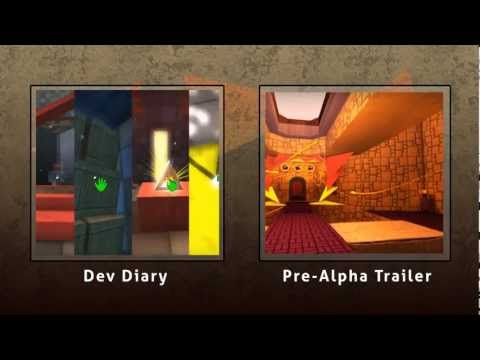
Just a little post to announce that we made a new gameplay trailer video thing, in preparation for the upcoming release of a demo and the alpha version!
(YouTube videos try to set cookies and contact Third Party servers!)
The current project page was updated, too - but hopefully we can move most of the stuff soon to www.tri-game.com!
Day 2 and 3 – Amaze Indie Connect
Missed Day 1 of our Berlin adventure? Click here!
After I failed at being more business-like and professional, we really enjoyed talking to all the Indies. Especially what they are working on, where their secret jelly glass filled with coins is to be found and, of course, how their business works.
This whole Indie thing was some kind of conference meme everybody interpreted in their own way. Many people reacted a bit bugged out when it comes to the question what is "Indie" and what not.
Some don't like the discussion, because we all need money and partnerships, which doesn't necessarily mean that we are the marionettes of publishers.
Others loved the Indie label to keep out stiff business guys and get recognized even with smaller titles.
And many folks prefer to just call all the little game company start-ups Indie, without making a distinction what it exactly means to be Indie.
Even Thorsten Storno – the host of Germany's first Indie festival didn't come up with a manifest. Although he wanted to, but couldn't afford doing one due to the lack of time. Luckily! Because maybe too many restrictions would contradict with the Indie mind of being independent from stupid guidelines. At least this can be said, I think.

A fact is, that we all need money and that a pure Indie-fication seems to be only possible with sponsorship, waiting tables, freelancing, putting aside our own projects to work at errands or being purely commercial from time to time. So in the end, everybody is Indie and nobody is.
At this point Cactus from Sweden comes in. He held the first talk/keynote and gave us all a telling-off about stopping to be so commercial. After his 2-year sponsorship ended he now has to sell his games, too. Ironic!
I really enjoyed his speech, though, especially as a contrast to the Quo Vadis - he stood there somehow drunk with a canned beer at 11am. Although I was a bit unsure what exactly his point is, but I think he was as confused about him being business punk now, as I was.
Cactus' talk strongly reminded me of Anna Anthropy's book “Rise of the Videogame Zinesters”. Both complain that on the one hand making games is easier than ever, but on the other hand, it is harder to get an audience with free games or in other words, the barrier to gain a foothold is getting higher.
The funny thing about this discussion is that I – as somebody who tries to sell games – saw this always from another perspective: There are tons of awesome and super-creative free games and I never understood why the heck they gave them away for free. Because it basically means that I as an Indie dev who needs money has to explain myself for being greedy.
The developers of free games - on the other side - argue that they get no coverage for not having polished, super-functional games. They seemed to be the Indie Indies, the artsy ones, while we are the black suits.
The good thing is that most of us do both ways, which brings the whole discussion together somehow and makes it dispensable.
I have to admit that I didn't follow most of the talks, again. I think my attention span is extremely short and every talk was followed directly by the next one. A little pause to discuss what you heard just moments ago is very important.
Especially when controversies occur: Martin Nerurkar's talk was about to use every possibility to make and sell games - even free2play. This was followed by a discussion that our creativity should not be destroyed by, let's say, free2play. Like I mentioned in the post about Quo Vadis, free2play and social games are the end of creativity to many game developers. This kind of friction was fascinating.

The talks on the next day were interesting and very inspiring, too. Douglas Wilson, member of Die Gute Fabrik and brain behind Johann Sebastian Joust, compared his game with the minimalism in Proteus. He pulled a metaphor about gameplay being the chips and the surroundings, graphics, atmosphere, etc, are the sauce. And Indies too often just think about the chips, which are flavorless alone, but he loves the dip and would be glad if the chips would be more often just used as a vehicle to eat more dip ... I think, that was what he meant!? Using tasty food pictures as a metaphor didn't work for me that well.
This speech was followed by a talk from Thomas Bedenk of Brightside Games about the Flow-theory by Mihaly Csikszentmihalyi and the difference of player and designer perspective. Well – look at the picture.

Vlambeer rocked with a lesson about back story. Although it's fun to hear this from the masters of fast-paced arcade games, in my opinion everybody comes up with some kind of fiction. Some for the need of design ideas, while others have a vast epic story early before even knowing about the gameplay. But it's nice to see them playing their games and understanding how every piece fits together. (You can re-read the talk here.)
The talks were followed by two workshops. Apparently there was even a third one, called "Lesson learned", but most people couldn't recall the content from the website and a rumor explained that it was about business ("About the art of staying independent") - I wonder if it took place anyhow.
The other ones were about sound and coding with libpd and location based games, the last one we took part in. It is extremely interesting to speak to people like Michael Straeubig, who is a game designer for board and location based games. I think our games belong to the PC, but it's always awesome to get some input from other genres, especially the offline ones.
Again I missed the outcome of this workshop. I think I was looking more for input then laying my hands on gameplay.
So instead we joined the others on a lawn enjoying the invasion of summer.

The summit closed with the award for the most amazing game, which was Proteus of Ed Key and David Kanaga.
I loved the decision, because I just bought the game some days ago and was fully inspired. I guess games like Proteus, that suck players into their world without any double-hint what is next or where to go now and what exactly is the point, was the perfect choice for the first award. It was in fact some kind of orientation which way the first edition of the festival should lead to.
Ed, your game is perfect for this, like the festival itself: Not too polished, leaving lots of room for own interpretation of what exactly will happen next.
The best thing, after the award, was the party with the mandatory 8bit electronic music and Proteus playable flashing against the wall. We sat there for a very long time and played it. The best thing: people came along and watched us.
After observing them, these are the five phases playing Proteus:
1. Skeptical look. "THIS won the award?" Erm....
2. Just fascinatingly watching, being completely silent.
3. Curiosity, what this thing exactly about. "What do I have to do, just walking?" or "Oh, I have to follow the frog!"
4. The deep wish to try it themselves.
5. "Oh my god this is awesome. I gonna buy this."
It's funny how people kept playing it, although being extremely confused about this "Notgame". I would love to achieve this one day, without a ragequit stopping people from doodling to find possibilities in the game out for themselves.


So, the big question from all, who missed the event: Was it worth going to Berlin? Just another Indie festival? "Germany? - I went to GDC San Francisco!" So, next year A.Maze, again?
Answer: Yes, YES, triple-yes. Just standing in the foyer and discussing different standpoints about business, money, gameplay or favorite beer labels made the thing awesome. Meeting many of the well-known faces in person and discover new ones you never heard of before. Or finally meeting the German developers in person, that seldom actively use Twitter or blogs - in most cases.
The talks were more an add-on to be inspired, provoked or initiated for further discussion. But I took home many good ideas, motivation and encouragement for our game-to-be TRI.
And it was fantastic to play all these games during the summit and nibble my nails about who is going to get the fantastic looking lolly-pink silicon concrete trophy. Great people overall … what should I say?
Thanks a lot to the organizers of the whole event! I miss Berlin, this whole communicative, relaxing AND exhausting event plus the international flair - Fuck yeah! In this scene I felt extremely welcome! Thorsten, this was amazing!!!
BTW: Next time with a game jam, please!